






 :
:


11月21日,馬來西亞最著名的英文報紙The Star(《星報》)正式開設了全球第一個英文報紙“人類命運共同體”主題專欄“On A Shared Future”,專欄發表了中國傳媒大學人類命運共同體研究院院長李懷亮教授的文章Who Won the Trade Wars?(“誰贏得了貿易戰?”)。
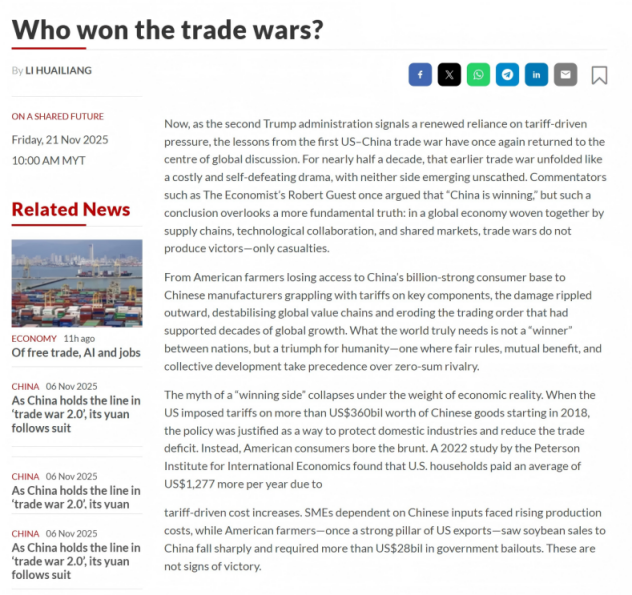
這是中國傳媒大學與馬來西亞拉曼大學共建的人類命運共同體東盟研究中心繼與百年華文報紙《星洲日報》(Sin Chew Daily)共同合作專欄后,探索在國外傳播人類命運共同體理念的全新創舉。以下轉載全文。
WHO WON THE TRADE WARS?
Li Huailiang
For nearly half a decade, the U.S.-China trade war has unfolded like a costly, self-defeating drama, with neither side emerging unscathed. Mr. Robert Guest , Deputy editor of The Economist, said “ China is winning” the trade wars. The Economist’s observation that “China is winning” overlooks a far more critical truth: in a global economy woven together by supply chains, technological collaboration, and shared markets, trade wars do not produce victors—only casualties. From American farmers losing access to China’s billion-strong consumer base to Chinese manufacturers grappling with tariffs on key components, the damage has rippled outward, destabilizing global value chains and eroding the very liberal trading order that once fueled decades of global prosperity. What the world truly needs is not a “winner” between nations, but a triumph for humanity—one where fair trade rules, mutual benefit, and collective growth take precedence over zero-sum rivalry.
The myth of a “winning side” in trade wars collapses under the weight of economic reality. When the U.S. imposed tariffs on over $360 billion worth of Chinese goods starting in 2018, it claimed the measures would protect domestic industries and reduce the trade deficit. Instead, American businesses and consumers bore the brunt: a 2022 study by the Peterson Institute for International Economics found that U.S. households paid an average of $1,277 more annually for goods due to the tariffs, while small and medium-sized enterprises (SMEs) reliant on Chinese inputs faced soaring production costs. Farmers, once a pillar of U.S. export strength, saw soybean sales to China plummet by 74% in 2018, forcing the U.S. government to allocate over $28 billion in bailout funds to offset losses—hardly a sign of “winning.”
China, too, has felt the pain. Tariffs on Chinese tech products disrupted access to U.S. semiconductors and software, temporarily slowing the growth of its high-tech sector. Exporters of consumer goods, from electronics to textiles, faced shrinking profit margins as they absorbed tariffs or lost market share to competitors in Vietnam, Mexico, or India. Yet framing this as a “loss” for China misses the point: the trade war has not been a contest to outlast one another, but a mutual drain on resources that could have been invested in innovation, infrastructure, or addressing global challenges like climate change. Both nations have spent billions shoring up industries affected by tariffs, diverting capital from areas that would have delivered long-term prosperity for their citizens.
The greatest casualties of the trade war, however, are not nations—but the global supply chains and vulnerable economies that depend on predictable, rules-based trade. For decades, the world relied on a system where components crossed borders multiple times: a smartphone might have chips from Taiwan, batteries from China, and assembly in Vietnam before reaching U.S. shelves. The trade war shattered this predictability. Multinational corporations were forced to restructure supply chains at enormous cost, often relocating production to avoid tariffs—a process that displaced workers in developing countries and raised prices for consumers worldwide. Small economies, in particular, were caught in the crossfire: countries like Malaysia, which supplies 70% of the world’s semiconductor packaging materials, saw export growth slow as demand from China and the U.S. wavered. The International Monetary Fund (IMF) estimated that the trade war reduced global GDP by 0.8% in 2020, a loss of over $700 billion—resources that could have lifted millions out of poverty or funded COVID-19 relief efforts.
This is why the narrative of “winning” a trade war is not just flawed, but dangerous. It reduces complex global interdependence to a simplistic contest of strength, ignoring the fact that every tariff, export restriction, or trade barrier harms real people: the American factory worker laid off when their company loses a Chinese contract, the Chinese farmer struggling to sell produce to the U.S., the Kenyan entrepreneur waiting for delayed tech imports to start a business. What the world needs instead is a victory for fair trade rules—rules that prioritize transparency over protectionism, mutual benefit over coercion, and shared growth over unilateral advantage.
Fair trade rules are not about “letting one side win,” but about creating a level playing field where all nations, large and small, can thrive. This means reforming institutions like the World Trade Organization (WTO) to address longstanding grievances—such as use of tariffs as a political tool—without abandoning the core principle of non-discrimination. It means rejecting “weaponization” of trade policy, and instead building resilient supply chains that benefit multiple countries. For example, a collaborative approach to semiconductor production—with the U.S. focusing on design, Taiwan on manufacturing, and China on assembly—could lower costs for consumers and reduce the risk of conflict over tech dominance.
Most importantly, a “world win” requires nations to recognize that global challenges—climate change, poverty, pandemics—cannot be solved through trade wars. The transition to renewable energy, for instance, needs China’s manufacturing capacity for solar panels, the U.S.’s innovation in battery tech, and developing countries’ access to affordable green energy. A trade war that blocks technology sharing or raises costs for renewable goods slows progress for everyone, condemning future generations to a warmer planet.
The U.S.-China trade war has shown that there are no winners in zero-sum conflicts. The Economist’s focus on which nation is “winning” distracts from the far more urgent task: rebuilding a global trading system that works for humanity. This will not be easy—it requires compromise, trust, and a rejection of nationalist rhetoric that frames other nations as enemies. But the alternative is clear: more tariffs, more supply chain chaos, more poverty, and a world where no one truly thrives.
Let us stop asking “who is winning?” and start asking “how can we all win?” Let us work to strengthen fair trade rules, support vulnerable economies, and prioritize collective growth over individual gain. When the world wins, America wins, China wins, and every person—from the farmer in Iowa to the entrepreneur in Shenzhen to the child in Kenya—wins. That is the victory we should all be fighting for.
誰贏得了貿易戰?
李懷亮
近五年來,美中貿易戰如同一出代價高昂、得不償失的鬧劇徐徐展開,雙方均未能全身而退。《經濟學人》副主編羅伯特?格斯特先生稱 “中國正在贏得” 這場貿易戰。但該刊這一 “中國獲勝” 的論斷,卻忽視了一個更為關鍵的事實:在這個由供應鏈、技術協作和共同市場交織而成的全球經濟中,貿易戰沒有贏家,只有受害者。從失去中國十億級消費市場的美國農民,到苦苦應對關鍵零部件關稅的中國制造商,其破壞效應不斷向外擴散,既動搖了全球價值鏈的穩定,也侵蝕了曾推動全球數十年繁榮的自由貿易秩序。世界真正需要的,并非國家間的 “勝負之分”,而是人類的共同勝利 —— 讓公平貿易規則、互利共贏與集體發展凌駕于零和博弈之上。
貿易戰存在 “勝負方” 的說法,在經濟現實面前不堪一擊。2018 年起,美國對價值超3600 億美元的中國商品加征關稅,聲稱此舉將保護本國產業并減少貿易逆差。然而,最終承受沖擊的卻是美國企業與消費者:彼得森國際經濟研究所2022 年的一項研究顯示,關稅導致美國家庭年均多支出1277 美元購買商品,而依賴中國輸入品的中小企業則面臨生產成本飆升的困境。曾是美國出口支柱的農民群體,2018 年對華大豆銷售額暴跌74%,迫使美國政府撥付逾280 億美元救助資金以彌補損失 —— 這絕非 “獲勝” 的跡象。
中國同樣遭受了沖擊。針對中國科技產品的關稅阻礙了其對美國半導體和軟件的獲取,暫時放緩了高科技產業的發展速度。從電子產品到紡織品等消費品出口商,要么自行承擔關稅成本,要么被越南、墨西哥或印度的競爭對手搶占市場份額,利潤空間不斷壓縮。但將這定義為中國的 “失敗” 卻偏離了核心:貿易戰并非一場比誰更能持久的競賽,而是對本可投入創新、基礎設施建設或應對氣候變化等全球挑戰的資源的雙向消耗。兩國均投入數十億美元扶持受關稅影響的產業,將資本從能為國民帶來長期繁榮的領域轉移開來。
然而,貿易戰最大的受害者并非特定國家,而是依賴可預測、基于規則貿易的全球供應鏈和脆弱經濟體。數十年來,世界依賴著一套商品組件多次跨境流通的體系:一部智能手機的芯片可能來自中國臺灣,電池產自中國內地,組裝在越南完成,最終銷往美國市場。貿易戰打破了這種可預測性。跨國公司被迫耗費巨資重組供應鏈,往往為規避關稅而遷移產能 —— 這一過程導致發展中國家工人失業,同時推高了全球消費者的購買成本。尤其是小型經濟體被卷入戰火:例如供應全球70% 半導體封裝材料的馬來西亞,隨著中美需求波動,出口增長陷入停滯。國際貨幣基金組織(IMF)估計,2020 年貿易戰導致全球GDP 下降0.8%,損失超過7000 億美元 —— 這些資源本可幫助數百萬人口脫貧或為新冠疫情救助提供資金支持。
這正是 “贏得貿易戰” 這一敘事不僅存在缺陷、而且具有危險性的原因。它將復雜的全球相互依存關系簡化為一場單純的實力較量,忽視了每一項關稅、出口限制或貿易壁壘都會傷害真實的個體:因公司失去中國合同而失業的美國工廠工人、難以向美國出售農產品的中國農民、等待延遲交付的科技產品以啟動業務的肯尼亞創業者。相反,世界需要的是公平貿易規則的勝利 —— 這些規則應將透明度置于保護主義之上,將互利共贏置于脅迫施壓之上,將共同發展置于單邊優勢之上。
公平貿易規則并非要 “讓某一方獲勝”,而是要創造一個所有國家無論大小都能蓬勃發展的公平競爭環境。這意味著改革世界貿易組織(WTO)等機構,解決長期存在的不滿 —— 例如將關稅用作政治工具等問題 —— 同時不放棄非歧視的核心原則;意味著拒絕貿易政策的 “武器化”,轉而構建惠及多國的韌性供應鏈。例如,半導體生產的協作模式 —— 美國專注于設計、中國臺灣負責制造、中國內地承擔組裝 —— 不僅能降低消費者成本,還能減少因科技主導權引發的沖突風險。
最重要的是,“世界共贏” 要求各國認識到,氣候變化、貧困、疫情等全球挑戰無法通過貿易戰解決。以向可再生能源轉型為例,這需要中國的太陽能電池板制造產能、美國的電池技術創新,以及發展中國家獲得可負擔的綠色能源的機會。阻礙技術共享或推高可再生能源產品成本的貿易戰,會減緩全人類的進步步伐,將子孫后代推向一個變暖的地球。
美中貿易戰已證明,零和博弈中沒有贏家。《經濟學人》執著于爭論哪個國家 “獲勝”,卻分散了對更緊迫任務的關注:重建一個為人類服務的全球貿易體系。這絕非易事 —— 它需要妥協、信任,以及摒棄將其他國家視為敵人的民族主義言論。但替代方案的后果顯而易見:更多關稅、更多供應鏈混亂、更多貧困,以及一個無人能真正實現繁榮的世界。
讓我們停止追問 “誰在贏?”,轉而思考 “我們如何才能共贏?”。讓我們共同努力強化公平貿易規則,支持脆弱經濟體,將集體發展置于個體利益之上。當世界獲勝時,美國會獲勝,中國會獲勝,每一個人 —— 從愛荷華州的農民到深圳的創業者,再到肯尼亞的孩童 —— 都會獲勝。這才是我們所有人都應為之奮斗的勝利目標。

 回到頂部
回到頂部